Showing posts with label Cinema. Show all posts

Wednesday, April 14, 2010

14/04/2010: Cinematic CV – Audrey Tautou

Often touted as the next Audrey Hepburn and always associated with her quirky interpretation of the adorably eccentric Amélie, Running in Heels examines the cinematic CV of enigmatic French actress Audrey Tautou.

http://runninginheels.co.uk/articles/cinematiccv-audrey-tautou/


First major films: Venus Beauty Institute and Amélie
Most recently released film: Coco before Chanel
Significant acting awards to date: César award for Most Promising Actress (1999)

“It was a passion, of course, but I thought I would give myself one year, and if at the end I hadn’t done what I wanted, I would do something else.”
Audrey Tautou, 2005

Audrey Tautou may be one of France’s finest actresses but she could have just as easily have been something completely different if things hadn’t gone her way. Fortunately, she didn’t have to confront the possibility of failure for long though – she won the ‘Most Promising Actress’ award at the Césars (the French equivalent of the Oscars) for her very first major film role.

Early Work in French Cinema

Tautou’s role in Venus Beauty Institute (1999) garnered her industry acclaim but she was catapulted to worldwide fame courtesy of her role as the title character in Amélie (2001), the adorably quirky tale of a young waitress in Montmartre who dedicates her life to bringing happiness to others.

It’s interesting – almost frightening, even – to think that Tautou was not director Jean –Pierre Jeunet’s first choice for the role: he had originally written the part for Emily Watson, who eventually withdrew from the role. Having spotted Tautou’s face on a poster for Venus Beauty Institute, he took a chance in casting this still relatively unknown actress as Amélie. Ultimately, her portrayal of the wide-eyed and eccentric Amélie was instrumental in the film’s success, as she captured the heart of filmgoers worldwide.

In the years following the success of Amélie, Tautou seems to have chosen to remain beneath the radar, shirking big budget movies and the high-profile offers which surely must have come her way.

 Definity more pretty than dirty in dirty pretty things

She did take her first English speaking role in gritty drama Dirty Pretty Things (2002), during this period although she seems to have preferred to stay within the French film market. Another film she acted in during this period is cult Erasmus favourite Pot Luck  (L’auberge Espanole – 2002) - a brilliantly funny take on the year abroad experience.

Her next major success in a film role came courtesy of a second collaboration with Amélie director Jean–Pierre Jeunet, in A Very Long Engagement (2004). Whilst many wrongly presumed the film would by ‘Amélie 2’, it too achieved much success garnering Tautou nominations for Best Actress at both the César and European Film Awards.
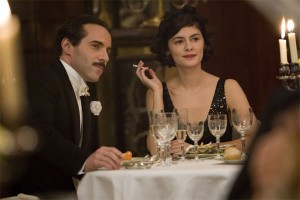
Oozing Gallic Glamour as Chanel

Hollywood Calls!

Given Tautou’s apparent penchant for smaller movies, her presence in The Da Vinci Code (2006) came as a surprise to many, not least the actress herself; ‘I really didn’t think I was right for it either… it’s certainly not my dream to drop everything for Hollywood’ . This, her first Hollywood production, did not win her any industry acclaim but it did mark her first steps into the big leagues playing opposite Tom Hanks in the film version of the bestselling novel by Dan Brown, making her more recognisable among film audiences worldwide.

Whilst more French movies followed her foray into Hollywood, Tautou choose to remain in the spotlight taking on the role of leading lady Coco Chanel in the biopic of the fashion designer Coco Before Chanel (2009). Whilst it by no means clear where Tautou will go from here, it’s safe to say her acting career will be one to watch over the coming years.

Tuesday, February 9, 2010

8/2/10: Cinematic CV: Penelope Cruz

Fresh from the announcement of her Oscar nomination for Best Supporting Actress in Nine, Running in Heels examines Penelope Cruz’s cinematic CV to date


First major films: Jamón Jamón and Belle Epoque.
Most recent released film: Nine.
Films awaiting release: Cameo in Sex in the City 2.
Significant acting awards to date:
  • Oscars: Winner of Best Supporting Actress for Vicky Cristina Barcelona and three nominations to date (Best Actress for Volver, Best Supporting Actress for both Vicky Cristina Barcelona and Nine).
  • Goyas (Spanish Academy Awards): Winner of three Goya’s (Best Actress for The Girl of Your Dreams and Volver; Best Supporting Actress for Vicky Cristina Barcelona).
Cruz in latest film 'Nine'

With her third Oscar nomination announced at the beginning of February, Penelope Cruz is now acknowledged as a great actress on the world stage. But it hasn’t always been this way. Until recent years, Penelope lived an extremely schizophrenic cinematic life being feted in Spain for her talent yet appearing in lacklustre Hollywood movies as the token eye candy. From the dreadful Woman on Top to the Oscars via many excellent Spanish films and three Goyas (Spanish Academy awards), we take a look at Cruz’s cinematic CV.

Early Work in Spanish Cinema

Cruz in her début role in 'Jamón Jamón'

Cruz’s first significant breakthrough was in the starring role of Jamón Jamón (A Tale of Ham and Passion) in 1992. A number of films followed including her acclaimed performance in Belle Époque which won the Oscar for Best Foreign Language Film in 1994.

However two things happened in 1997 which were to catapult her to stardom within her native country. Firstly, she had her big break in Spanish director Alejandro Amenabar’s film Abre los Ojos (Open your eyes). Then, following her small role as a prostitute giving birth on a bus in Pedro Almodóvar’s Live Flesh (Carne Trémula) in 1997, she became his muse and in the years that followed appeared in many of his films.

Her most notable role in the Almodovar oeuvre prior to her foray into Hollywood is arguably All About my Mother (Todo Sobre Mi Madre) for which the director won an Oscar for the Best Foreign Language Film in 1999. Cruz was feted for her performance in the movie and this, her second appearance in an Oscar winning movie, allowed her to launch her career in Hollywood.

Hollywood Calling!

Despite the burgeoning industry acclaim, Cruz was still relatively unknown to the public outside of Spain. Her Hollywood career began with a role in Hi-Lo Country, followed a role in the questionable Woman on Top (I know, this is the second time I’ve mentioned it, but it really is that bad). However, 2000 was to signal the start of Cruz’s upward trajectory in Hollywood. With parts in All the Pretty Horses, Blow, and Captain Corelli’s Mandolin, her star was on the rise. This was inevitably accelerated following her performance in Vanilla Sky – the English language remake of Abre los Ojos – when it came to light that she was dating co-star Tom Cruise.

Regrettably, this relationship with the recently divorced Cruise seemed to stunt her progress in Hollywood as an actress, thrusting her into a relentless tabloid furore – Cruise divorces Kidman, begins dating Cruz during proceedings, Cruz begins appearing in People magazine’s annual Most Beautiful People list, Cruise and Cruz break up…

CV schizophrenia sets in

Yet despite this, her European cinema career was still flourishing as she returned to Europe to learn Italian and star in Italian film Non ti muovere (Don’t Move) in 2004. This was another resounding European success for which she won both the David di Donatello (equivalent of Academy Award in Italy) and European Film Award for Best Actress. Yet, following this success, Cruz returned to Hollywood and starred alongside Matthew McConaughey in Sahara. She also began dating McConaughey and seemed to cement her place in the public eye as eye candy in English language films and hot girlfriend to her leading men.

Worldwide Acclaim

Thankfully, following a break up from McConaughey, Cruz returned to her roots and appeared in 2006’s Volver, reigniting the partnership with Almodóvar. The movie was a resounding success worldwide and Cruz was the first Spanish actress to be nominated for an Oscar for Best Actress. Unfortunately she lost out to Judi Dench but did win a Goya for the role in Spain.

This Oscar nomination finally signalled Cruz’s entry into the Hollywood big-time.


Cruz with her Best Supporting Actress Oscar for 'Vicky Cristina Barcelona'

She filmed Vicky Cristina Barcelona with Woody Allen (acting her American counterparts in the film off the screen) and took home the Best Supporting Actress Oscar in 2009, not to mention Javier Bardem. Her Hollywood status was cemented with a third Oscar nomination for the 2010 Oscars in the Best Supporting Actress category once more, for her role as Daniel Day Lewis’ Italian mistress in Nine.

Her chances of winning are uncertain, given that she lost out on a Golden Globe for the role, but Cruz is now a star both in Hollywood and Spain, something the Spanish will never forget about their beloved ‘Pe’.

8/2/10: Where are the Plus Size Men?

There’s been a furore over plus size female models, but what about plus size men? Have they been overlooked or are men just generally more accepted at a larger size?

The furore over the use of unrealistically sized female models is gradually abating as women are being represented in the fashion world in a more relatable way, which takes into account that there are more sizes than zero. For females, a plus size is usually anything over a UK size 18. Whilst the fashions worlds’ view of a plus size female is still slightly skewed they have at least taken steps towards altering the size and shape of females that they present to us. Please note the use of the word skewed though, as in the modelling world a plus size model is more likely to be represented by a size 14 model than an actual plus size model.

Nevertheless, these steps together with the continuing championing of a larger female size in the media, means that plus size females are no longer airbrushed out by the fashion or media industries. For evidence of the changes that have been wrought, look no further than V Magazines’ January 2010 ‘Size Issue’ with shots such as this one illustrating the mindset that big is beautiful too.


V Magazine's 'Size issue'

There’s no doubt that the media and fashion are now championing the plus size female cause. But what about the plus size men? A plus size man is generally defined as anyone over a size UK XL. The issue of the plus size man and how he is depicted in the media and fashion has not been raised in any significant way to date. A quick Google search yields none of the debate associated with plus size women so what does this mean? Have men been forgotten about? Or are men simply more accepted at a larger size?

Are men accepted at a larger size?

Men‘s size is not seen in such simplistic terms as women’s size. Until now women have been led to believe often believe that the size they need to be is the smallest size possible because the images that have been presented to them. However the majority of men do not have this fat / thin mentality. It would seem that being a plus size man does not carry as much stigma as being a plus size woman.

The reason there is less stigma attached to being a plus size man is that men are presented a different body ideal to live up to. This can be seen in the precedence of body shape over body size in the images presented of men. Although the body shape presented on the catwalks in usually quite thin, the ideal male body presented to us is not necessarily thin.

However whilst men may be seen as acceptable at a larger size, this too is limited to a certain sort of shape. Which is why you don’t see Kellogg’s promoting a ‘Little Red Suit’ challenge, but you do see stacks of health supplements calling to men from health shop windows touting promises like muscle gain.

However, the lack of plus sized men is not limited to the fashion industry, its spreads right across many different areas – two of which, advertising and entertainment, demonstrate that whilst men’s bodies may not be the subject of the intense scrutiny women are subject to, this is not necessarily a good thingfrom the perspective of making the fashion industry even more inclusive.

The Advertising Industry

A svelte Calvin Klein model

Plus size men are rarely seen in advertising. The way men are portrayed in advertising, as with women, has nothing to do with reality but rather the message advertisers are trying to put across and who they are trying to put it across to. So for example, L’Oreal Paris used Pierce Brosnan as the spokesperson for their male grooming range as he appeals to women and their husbands who want to be him. Ditto David Beckham and the Armani underwear ads. Plus sized men can be seen selling plus sized clothes in clothing catalogues but apart from that advertising, as always, perpetuates an image that is little reflection of reality.

Men on Screen

The entertainment industry is a good example of how larger men are depicted in the media. Men and women, for better or worse, are not portrayed the same way. In the media and films and many other areas of life, women’s appearance and size has always been focused on more.

The storyline of Shallow Hal was incredible to many because the plus size woman was considered to be beautiful by one man, albeit under the influence of hypnosis. However, the beautiful Katherine Heigl falling for a pudgy Seth Rogen in Knocked Up barely raised an eyebrow.

Heigl and Rogen in Knocked Up

So, plus size male models are inevitable?

The fact that men’s appearance is not as discussed a topic means that plus size men are becoming more and more marginalised by the fashion industry. The fat / thin stigma is the root of the plus size female model controversy and led to the subsequent acceptance of larger female sizes by the fashion industry. However, just because plus size men are not as stigmatised as plus size women, this does not mean they are any less marginalised.

Men have been overlooked because they haven’t demanded to be taken into account, and these industries aren’t going to automatically include them. The achievement of a plus size female model industry followed a battle hard fought and it will be the same for plus size men should they decide to take up the fight

Wednesday, December 2, 2009

1/12/09 - Animated Films – Fun for all the Family?

Animated films with some in jokes for ‘grown ups’ have suddenly made taking your little cousin to the cinema fun again. But how, why and thanks to who has this trend emerged?


Something has happened in the world of animated movies.

Traditionally the preserve of children, in recent years they’ve become just as popular with adults – and not necessarily just the parents who accompany their kids. Jokes, one liners, soundtracks and actors have been carefully selected to appeal to the grownups, thus elevating animated films out of the babysitter’s trek to the Saturday afternoon matinee and into our DVD collections.

The fact that animated movies are now targeting adults as much as (if not more than) their primary audience of children is a much discussed topic. A quick Google search can lead you to a range of complaints from outraged parents at the content of selected ‘childern’s’ films, such as the following comments about Shrek: ‘I very seriously doubt that we will attend another movie made by DreamWorks if this is what you think is intended for children’ and ‘Please consider the impact your productions have on children and be responsible’. Is such outrage merited? Have animated movies really lost sight of who their true audience is?

(Looking towards Lord Farquaad's Castle) 
Shrek: Do you think maybe he's compensating for something?

Once upon a time…

Adults have always been part of the intended audience for animation, although, unlike Shrek, animation has not always been aimed at children and adults at the same time. The Simpsons is similar to Shrek in that it appeals to both adults and children however the adult themes it deals with – Homer’s alcoholism, marital affairs, mockery of the overly Christian Flanders family – has resulted in many people deeming it unsuitable for children also.

Betty Boop, the first cartoon character to depict a fully sexualised woman, appeared in cartoons and comic strips which were aimed at adults initially, only later changing to appeal to a younger market. However the demise of Betty Boop was attributed in part to this change in direction. Nevertheless, her legacy lives on today with a vast array of merchandise which appeals to all ages and she still reigns as one of the undisputed queens of animated sex symbols (rivalling Jessica Rabbit, of course). Other animated productions are more obviously targeted towards teens and adults – among them Beavis and Butthead, Ren and Stimpy and my personal favourite Daria.

Betty Boop: Pin-up for kids?

Disney may be seen by some as the kindly grandfather of animated movies in comparison to the evil Dreamworks studios who have created these satiric animations targeted at hybrid audiences. However, whilst past Disney films did not subvert the stories they told, they did push the limits of children’s endurance with terrifying characters like the Wicked Stepmother in Snow White and the Evil Maleficent in Sleeping Beauty. (There is also more than one person who has set about proving the existence of subliminal sexual messages in Disney films although this theory appears to have more cynics then supporters). The controversy with a film like Shrek lies in its dual target audience…

And then there was Shrek

Whilst Shrek did not introduce the idea of satire and appealing to adults and children in animated movies, there is no doubt that the success of the movie spurred on similar productions afters its release.

Whilst the story of Shrek contained important moral lessons for children (e.g. don’t judge on appearances), it also subverted the traditional prince and princess story entirely by having the ogre getting the girl and the fair princess turning into an ogress. Its all star cast including Mike Myers and Cameron Diaz was easily recognisable for the adults in the audience; the soundtrack featured tracks from The Proclaimer’s ‘I’m a Believer’ to Hallelujah was designed to appeal to those who recognised the songs; while the endless quips and one-liners were clearly intended for the grown-ups. While Although such humour is a welcome relief from saccharine fairytales of old it may have been a step too far for some.

The major debate about Shrek rests on the fact that a lot of what is said is not suitable for children. Whilst explaining some of the jokes to children (specifically the one about Lord Farquaad’s castle) might cause you to cringe, questions about why people are laughing are inevitable one a child gets past a certain age. Similarly the humour in A Shark’s Tale, specifically in scenes such as the shark’s AA-style meeting to deal with their fish eating addiction, the humour is directly aimed at the adults receptive to its double meaning, which bypasses its younger audience completely.

A Shark's Tale

Money, money, money…

Ultimately, the existence of a classification system means that each parent should make the decision himself about whether or not a movie is suitable for their child(ren). Shrek, for example, was rated PG (‘Parental Guidance’) in the UK. If parents deem a movie unsuitable for their children, it is their responsibility to make sure they don’t see it.

Nowadays, a typical fairytale movie is more surprising than a parody with movies like Enchanted being marketed to a wide age range. Regardless of complaints from a minority, the indisputable success of the satire formula means that studios will keep producing movies like these for as long as there is an audience who wants to see them, and they keep the studios in profit

Wednesday, November 4, 2009

4/11/09 - Life after cinema

This artice orginally featured on Running In Heels - http://runninginheels.co.uk/articles/life-after-cinema/
This is the unedited final draft I submitted. Spot the difference! :P

Imagine if you will the following scenario; your job enables you to travel all over the world, your pay packet is in multiple digits, and your face is recognised globally for your work. The perfect situation it would seem… Or is it?

Earlier this year Viggo Morteson gave an interview declaring that he was finished with the movie making business setting the internet abuzz with speculation about whether or not he had quit acting for good. In the past, actors like Greta Garbo and Gene Wilder have retired from acting after long and successful careers. However an actor at the top of his game like Viggo declaring his intention to stop producing movies is hard to believe because if they quit, the profession loses an actor in their prime. Plus in these recessionary times it’s hard for us regular citizens to understand the motives behind giving up what seems to be the perfect job. We take a look at actors who have declared their intention to throw in the towel and what happened next…

I just don’t believe it…

Joaquin Phoenix has to be my favourite quitting story. He announced last year that he was quitting acting to become, wait for it, a rapper. Yes Joaquin Phoenix wants to be a rapper. This is the man who was nominated for an Oscar for Walk the Line and has appeared in such great movies as Two Lovers, Gladiator, Signs, and my personal favourite – Parenthood. However despite the fact that he hasn’t worked as an actor since his announcement, it’s still difficult to believe. The most popular theory is that he is doing it as an (extraordinarily elaborate) prank for his as yet unnamed 2010 documentary directed by Casey (brother of Ben) Affleck which is supposedly about his transition from actor to rapper. IMBD lists the documentary, scheduled for release in 2010, as being in post production so only then will we see whether or not it’s all an elaborate hoax. Although I must admit that should he release an album I’d probably buy it just to see what it’s like. However if his debut performance is anything to go buy I’m not expecting much.

Viggo Morteson, in the now much quoted interview he gave whilst publicising Eastern Promises, painted a picture of the job that we don’t generally imagine when we think about the fabulous lifestyles of the rich and famous; ‘In the past week I've been from Los Angeles to Japan to Korea to Poland to the UK. It's ridiculous and it's not a healthy way to be. But, as it happens, I'm taking measures to change that. No more movies.’

He is best known for his role in Lord of the Rings as Aragorn but he has been working as an actor pretty much consistently since the mid eighties. However, acting is not his only talent and he also writes poems, paints, photographs and is a jazz singer. He also owns a publishing company and holds a degree in Government and Spanish. Phew! As a man with so many interests it is not entirely shocking that he would consider a break from movie making and the subsequent publicity trail given that he could follow so many other routes. Throw in the fact that he’s 51 (I know, I couldn’t believe it either) and a career change is no longer so surprising.

However it would seem that, as frequently happens with the internet, his comments were blown completely out of proportion as evidenced by the 20,400 results for the search term ‘Viggo Morteson quitting acting’ in Google. Viggo himself silenced the speculation during a press conference for the movie The Road saying "I was just honest with someone a little while back who asked me if I had a movie lined up. I said 'no' and they wrote 'Oh, he's quitting.' I never said it," Talk about a storm in a tea cup but at least he knows he’ll be missed if he ever leaves the acting profession for good!

It’s not goodbye, it’s see you later…

Of course actors taking a break are not uncommon. Daniel Day Lewis is arguably one of the most selective and talented actors of his generation. However he disappeared from the acting world following The Boxer (1997) and became an apprentice shoemaker (perhaps Joaquin’s rap career is not so strange after all!). He didn’t appear in another movie until his Oscar winning role in Gangs of New York in 2002. Since 2002 he has only appeared in two released movies, both of which have garnered him awards and award nominations. He has a mere two more movies in the works. Truly he exemplifies the phrase ‘quality over quantity.’

Sean Connery, on the other hand, has yet to emerge from his self imposed retirement. Following the League of Extraordinary Gentlemen (2006) he decided to retire from acting. Since he has been true to his word and the only acting role he has taken has been as the voice of the main character in an animated short about a vet working in a Scottish village. This role was surely taken for his love of Scotland rather than a desire to return to acting. In 2009 he co-wrote a book called ‘Being a Scot’ which deals with the subject of Scotland as well as his life.

Look at me…

As evidenced by Viggo Morteson any suggestion that you are planning to stop acting will bring you a lot of attention, unwanted or otherwise. As a publicity or work hungry actor this could be exactly what you need. Although I may be slightly cynical, I can’t help but notice that some stars seem to discuss quitting acting at the most appropriate times.

Let’s take the example of Mischa Barton. This week she was quoted as saying that she was planning to quit TV to concentrate on more serious roles following the cancellation of her most recent TV series ‘The Beautiful Life.’ While this may well be her intention it does seem to be a way of her asking for more roles in the most public way possible. Let’s face it, ‘I’m quitting television’ is a lot more dramatic then ‘Can I have a movie role please? My TV show just got cancelled’

So Mischa, learn from the experts above, take a break and go do something different for a while. Be a rapper, train to be a shoe maker, write a book or alternately go completely crazy and design a leggings line and head up a fashion house. Well if Lindsay Lohan can do it….

Tuesday, November 3, 2009

3/11/09 - Life After Cinema

A succession of actors have recently threatened retirement or actually done it – we unravel the myths and motivations…


Imagine, if you will, the following scenario: your job enables you to travel all over the world, your pay packet is in multiple digits, and your face is recognised globally for your work. The perfect situation it would seem… Or is it?

Earlier this year Viggo Mortensen gave an interview declaring that he was finished with the movie-making business, and in the process set the internet abuzz about whether or not he had quit acting for good. In the past, actors like Greta Garbo and Gene Wilder have retired from acting after long and successful careers. However, for an actor at the top of his game like Viggo to declare his intention to stop producing movies, is harder to believe because it threatens to deprive the profession of an actor in his prime. Furthermore, in these recessionary times, it’s hard for us regular citizens to understand the motives behind giving up what seems to be a dream job. We take a look at actors who have declared their intention to throw in the towel and what happened next…

Hard to believe?

Joaquin puts what's on his mind onto his knuckles

Joaquin Phoenix unexpectedly announced last year that he was quitting acting for a new career – in rapping. Phoenix was of course nominated for an Oscar for Walk the Line and has appeared in a host of highly successful movies including Two Lovers, Gladiator and Signs. Yet despite the fact that he hasn’t worked as an actor since his announcement, it’s still difficult to believe. The most popular theory is that he is doing it as an (extraordinarily elaborate) prank for his as yet unnamed 2010 documentary directed by Casey (brother of Ben) Affleck which is supposedly about his transition from actor to rapper. IMBD lists the documentary, scheduled for release in 2010, as being in post production so only then will we see whether or not it’s all an elaborate hoax. Whilst his debut performance might not blow anyone’s socks off, I for one might be forced to purchase any prospective album out of sheer curiosity.

Viggo Mortensen, in the oft-quoted interview he gave whilst publicising Eastern Promises, painted a picture of the acting profession that we don’t generally think about; ‘In the past week I’ve been from Los Angeles to Japan to Korea to Poland to the UK. It’s ridiculous and it’s not a healthy way to be. But, as it happens, I’m taking measures to change that. No more movies.’

He is best known for his role in Lord of the Rings as Aragorn but he has been working as an actor fairly consistently since the 1980s. Aside from acting, Mortensen also writes poems, paints, photographs and sings jazz. Furthermore, he owns a publishing company and holds a degree in Government and Spanish. It’s not unsurpring that a man with so many interests might want to take a break from the business of movie making (since acting is indeed such a small part of an actor’s commitment to a movie). We may be worrying for nothing, however, as Viggo attempted to silence the speculation about his career during a press conference for upcoming movie The Road, when he said “I was just honest with someone a little while back who asked me if I had a movie lined up. I said ‘no’ and they wrote ‘Oh, he’s quitting.’ I never said it,”. So we may see him again sooner than we expected.

It’s not goodbye, it’s see you later…

Of course actors taking a break are not uncommon. Daniel Day Lewis is arguably one of the most selective and talented actors of his generation. However he disappeared from the acting world following The Boxer (1997) and became an apprentice shoemaker. He didn’t appear in another movie until his Oscar-winning role in Gangs of New York in 2002. Since 2002 he has only appeared in two released movies, both of which have garnered him awards and award nominations. A true exemplar of ‘quality over quantity.’

Day-Lewis in Gangs of New York

Sean Connery, meanwhile, has yet to emerge from his self-imposed retirement. Following the League of Extraordinary Gentlemen (2006) he professed to call time on his acting career. Since then, he has been true to his word and has only performed as the voice of the main character in animated short Sir Billi the Vet, a role which perhaps seduced him in through its Scottish theme and setting. Indeed in 2009 he co-wrote a book called Being a Scot which deals with the subject of Scotland as well as his life.

Look at me…

As the threat to abandon acting has proved itself an excellent attention-generator, it is hard not to wonder how often it is part of a carefully crafted PR strategy. On the other hand, it also makes an excellent story, and so we may have our fellow journalists to blame for whipping up a frenzy.

However, whatever one’s profession, to quit while one’s ahead, or at least before one ‘gets behind’ and enters a professional drought where perhaps the jobs aren’t forthcoming, somewhat insures an actor against accusations of being ‘over the hill’ or undesirable. Perhaps this – more than fatigue, other creative interests, or the demands of one’s family – might be a factor worth considering in the context of the ego, pride and sensitivity that are often associated with actors…